
Colombia Cannabis Attorney Juliana Salazar on International Cannabis Law, Latin America, and Building Across Borders

Updated: Apr 26
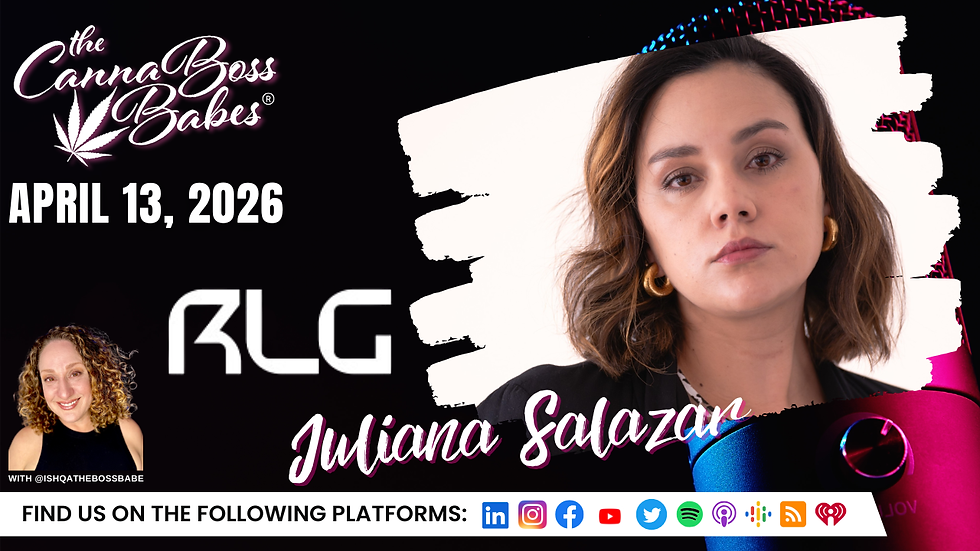
Juliana Salazar is Of Counsel for Latin America at Rudick Law Group — yes, the same firm you know from Victoria Cvitanovic — and she is covering ground in the cannabis space that most people in the U.S. don't even know exists.
We talked about Colombia's cannabis market, the global green rush pattern that keeps repeating itself, what it actually looks like to build a compliant cross-border cannabis business, and a whole lot more. This one got real fast and I loved every second of it.
Who Is Colombia Cannabis Attorney Juliana Salazar?
Juliana Salazar is a Colombian-licensed attorney and entrepreneur with over eight years of experience advising founders, operators, and investors on corporate law, regulatory compliance, and cross-border business strategy in highly regulated industries, including cannabis and adjacent wellness markets. She supports early-stage and revenue-positive companies with corporate governance, contract negotiation, regulatory strategy, and international market entry — helping teams build compliant, scalable, and commercially sound operations across Latin America, North America, and Europe.
Her background includes leading legal and operational functions for multinational teams, supporting capital raising efforts of more than US$2 million, and driving six-figure revenue growth for early-stage ventures. Juliana brings a practical, business-forward approach to corporate structuring, cross-border transactions, import/export compliance, and B2B go-to-market execution for companies operating in complex regulatory environments.
Recognized for bridging legal rigor with business strategy, Juliana is bilingual in English and Spanish, an international public speaker and educator, and has been recognized by CNN for her expertise in the cannabis market. She is also a co-founder of Colombia Legal Edge.
How She Got Here
Juliana didn't plan on cannabis. She graduated law school in Colombia, spent time working for a British journalist advising European investors on extractive industries in Latin America — oil, gas, mining — and watched that world start to collapse under the weight of its own bad reputation.
At her mom's recommendation, she pivoted to medical cannabis. Her mom told her, "You're kind of the more open attorney. Maybe this could be interesting." So she started researching and quickly noticed the same pattern she'd seen in mining playing out all over again — the get-rich-quick rush, the inflated promises, the lack of actual understanding of what was being sold.
She and the British journalist she worked for launched a business intelligence publication called the Colombia Cannabis Investor to cut through the noise. He wrote the journalism. She did the legal analysis. And together they tried to be the conscious voice in a room full of people convinced they were about to become millionaires
"We're gonna cultivate high quality weed to sell in California," she heard over and over. Her response every time: "You can't do that. You can never do that."
The Green Rush Pattern — And Why It Keeps Repeating
This is one of the most important parts of our conversation and I want everyone to hear it clearly.
Juliana has watched the same story play out in Colombia, Thailand, Panama, and markets across Latin America. Legalization happens. Excitement builds. Investors rush in without understanding the plant, the regulations, or the local context.
Promises get made that can't be kept. The market destabilizes. Rollbacks happen.
Colombia had a quota to produce 45% of the world's medical THC. Nobody understood what that actually meant. Millions of dollars poured in anyway.
Bangkok became one of the most visited cities in the world after legalization — partly because of wellness tourism — and then had to roll back because the infrastructure, the knowledge, the regulatory framework just wasn't ready.
Her take on all of it:
"It's very bold of us human beings to try to regulate something we don't understand and expect it to move at the pace we've set for it. It's not like alcohol. Cannabis is its own thing. It's a living being."
When we rush it, the patients lose. Every time.
What Colombia Looks Like Right Now
Colombia currently allows home cultivation of up to 20 plants — Juliana jokes that the judge who ruled on that number clearly has no idea how much 20 plants actually produces. Medical dispensaries are now allowed to dispense flower, which is a new development. The regulatory framework is still being finalized, but it's a step forward from the very narrow formulation-only model that came before.
She's also watching Ecuador working to pass full legalization, Brazil moving with some momentum, and Germany and Czech Republic taking a slower, more thoughtful approach — home cultivation at small scale, learning as they go — that she genuinely respects.
Argentina has been a perennial almost that never quite got there, and Mexico never fully developed its framework either.
Her focus is Colombia, because it's what she knows best and because she wants to bring people there who want to do it right.
Why Colombia Is Worth Considering for Plant Medicine Business
Juliana made a strong case and I'm going to let her points stand:
The institutions are stronger than people assume. There is real legal protection for entrepreneurs, both Colombian and international. Regulations are enforced. The old "messy country, get away with anything" reputation is outdated and Colombians are done with it.
There is genuine economic openness to new ideas, particularly in wellness. Businesses that serve patients and communities, built the right way, have real opportunity here.
And yes — because of currency, if you follow ethical standards and pay livable wages, it is simply more cost-effective than operating in many other markets.
That's not a loophole. That's economics.
She's reachable for anyone who wants to explore doing business in Colombia, ask questions about the country, or just understand what the regulatory landscape actually looks like right now.
The Bigger Conversation
We went a lot of places in this episode — patient advocacy, harm reduction, synthetic replicas versus the actual plant, the endocannabinoid system, Colombian culture, the loneliness epidemic, fast fashion, Costco overwhelming me spiritually, and my own upcoming move.
The thread running through all of it is something Juliana said that I keep coming back to:
"We have far more fear than we have education."
About plant medicine, about the countries and cultures we've never visited, about the people we haven't taken the time to ask real questions.
Catch the full conversation with Juliana on YouTube below.
Connect with Juliana Salazar:
LinkedIn: linkedin.com/in/salazarbonett/
Email: jsalazar@rudicklawgroup.com
Rudick Law Group: rudicklawgroup.com/people/juliana-salazar
Catch Juliana Live — Colombia Business Webinar April 30th
If this conversation sparked something for you, Juliana is hosting a webinar on April 30, 2026 at 10:00 AM Pacific and it is exactly the kind of honest, no-hype resource this industry needs more of.
The topic: what ethical, responsible business engagement in Colombia actually looks like — legally, operationally, and culturally. Because as she puts it, showing up is not the same as showing up right.
You'll walk away knowing where real opportunity exists in cannabis, wellness, and tourism, what mistakes foreign entrants make most often and how to avoid them, and what legal and regulatory essentials you need to understand before you commit. The foundation of the whole conversation is something we touched on in our episode too — respect, reciprocity, and accountability aren't soft skills in Colombia. They're how sustainable business gets built.
This is for you if you're a foreign investor, founder, or operator exploring Colombia, a foreigner already living there who wants to participate in rather than extract from the local economy, or a law firm or consultant looking for trusted local counsel for Colombia-bound clients.
Juliana's counsel is rooted in lived experience, not theory. This one is worth your Thursday morning.
👉 Register here: zoom.us/webinar/register/WN_hGwUnfzzTVaSWYIqKNi
Comments